
Starting a German A1.1 course in Berlin is much more than memorizing vocabulary and understanding grammar. It is the beginning of a continuous process in which you learn to structure your thoughts, express your ideas clearly and communicate with other people in different situations.
At the same time, a new language opens the door to a different culture and a different way of seeing the world. The way people express emotions, show politeness, disagree, make jokes or simply interact in everyday life reflects the society behind the language.
This is especially noticeable when you learn German in Berlin. The language is not limited to your German course: you experience it when starting a new job, studying at university, talking to colleagues, meeting new people, ordering something in a café, using public transport or simply interacting with people in your neighbourhood.
Learning German while living in Germany therefore also means experiencing the culture through its language and gradually becoming more confident participating in everyday life.
Grammar and vocabulary give you the necessary tools, but learning how to use them with real people gives those tools their purpose.
And this process has to start somewhere.
For complete beginners looking for a German course in Berlin, that starting point is usually German A1.1.
So, what exactly do you learn in an A1.1 German course? What can you realistically expect to do after completing it? And in a time when apps, online resources and AI are everywhere, what role do a teacher and a real classroom still play?
Let’s take a closer look.
Why Take a German Course with a Qualified Teacher?
Today, there are countless ways to start learning German on your own.
Language-learning apps, online exercises and artificial intelligence can all be useful tools. They can help you practise writing, check your spelling, learn vocabulary and complete grammar exercises.
We believe these tools can be excellent additions to a German course and to your independent learning.
But they also have limitations.
Language is fundamentally about human communication.
When you communicate with another person, you are not simply combining grammatically correct sentences. You are reacting to what someone says, interpreting their intentions, noticing body language, expressing emotions, asking spontaneous questions and adapting what you say according to the situation.
This is difficult to reproduce through an app alone.
A qualified German teacher does much more than explain grammar rules.
An experienced teacher can identify your strengths and weaknesses, recognize common mistakes from the very beginning and choose exercises, activities and methods that help you improve.
Sometimes a student understands a grammar rule perfectly but struggles to use it while speaking. Another student may communicate confidently but repeatedly make the same grammatical mistake without noticing it.
A good teacher can recognize these differences and respond to them.
Why Learning German in a Group Matters
There is another important element of a German language course: the other students.
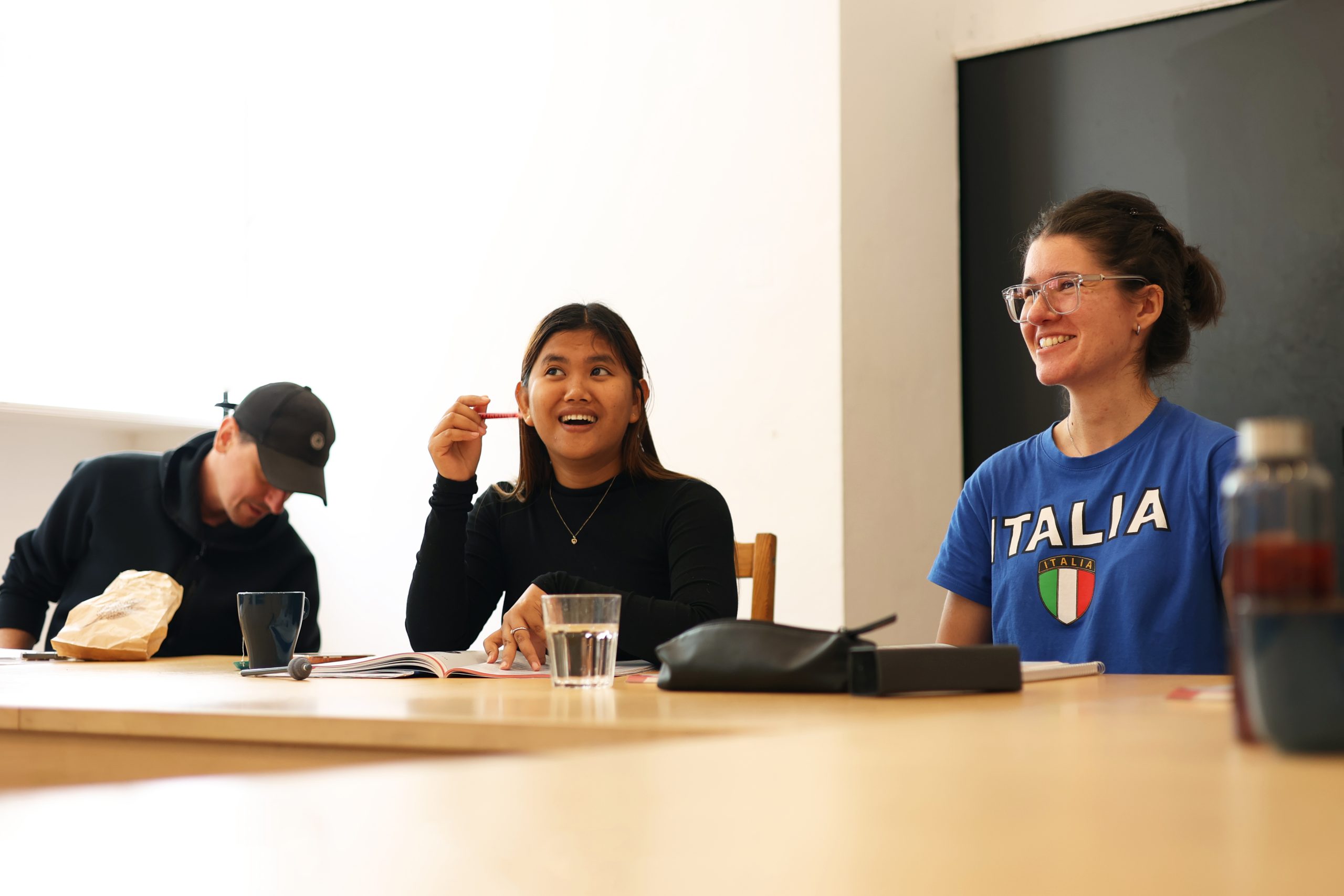
Learning German in a group means communicating with real people who think, feel and react differently.
A question might receive an answer you were not expecting. Someone may misunderstand you. You may need to explain your idea differently. Another student may ask you a spontaneous question.
This is real communication.
People have feelings, emotions, opinions and reactions that need to be expressed and understood both verbally and non-verbally.
A classroom gives you a safe environment to practise this from the very beginning.
In other words:
Learning a language with people helps you learn how to communicate with people.
Who Is a German A1.1 Course For?
A German A1.1 course in Berlin is designed for complete beginners with no previous knowledge of German, including people who have recently moved to the city and want to start learning from zero
A1 is the first level of the Common European Framework of Reference for Languages (CEFR), which organizes language proficiency from A1 to C2.
If you have just moved to Berlin and have never studied German before, this is normally the right place to start.
You do not need to speak German before beginning the course.
You also don’t need perfect English or another particular language to learn German.
What you need is a willingness to start from zero, participate actively and follow your teacher’s guidance with pronunciation, grammar, exercises and classroom activities.
During the first lessons, even very simple things can feel unfamiliar. German sounds different, sentence structure may be new and words can sometimes look surprisingly long.
That is completely normal.
The purpose of an A1.1 German course for beginners is to build the first foundations step by step.
What Do You Learn in a German A1.1 Course?
A1.1 introduces you to the fundamental building blocks of German.
At this stage, the goal is not to have long or complicated conversations. The goal is to give you the tools to understand and communicate in your first everyday situations in German.
German Pronunciation
Pronunciation is one of the central topics at the beginning of a German course.
It is also one of the things that worries many beginners most.
German contains sounds and combinations of sounds that may not exist in your native language. If pronunciation is ignored at the beginning, incorrect habits can become much more difficult to change later.
That is why we believe it is important to work on pronunciation from the first lessons.
You learn to listen carefully, recognize important sounds and reproduce them yourself. Your teacher can also immediately identify pronunciation difficulties and help you correct them.
The objective is not to sound like a native speaker.
The objective is to speak clearly and be understood.
German Grammar at A1.1 Level
Of course, grammar is also an important part of an A1.1 German course.
You gradually learn some of the structures that will accompany you throughout your German-learning journey.
Typical A1.1 grammar includes:
- Personal pronouns such as ich, du, er, sie, wir and ihr
- The verbs sein and haben
- Conjugation of regular and common irregular verbs
- Basic German sentence structure
- Questions with wer, wie, wo, woher, was and other question words
- Yes/no questions
- Definite and indefinite articles
- The first introduction to grammatical gender: der, die, das
- The nominative and first uses of the accusative
- Negation with nicht and kein
- Possessive articles such as mein and dein
- Basic modal verbs
- Separable verbs
- Numbers, dates and times
You don’t learn all of German grammar at once.
The structures are introduced progressively and, most importantly, connected to situations in which you can actually use them.
Vocabulary and Communication in an A1.1 German Course
Grammar only becomes useful when you can use it to communicate.
That is why vocabulary and everyday communication play such an important role in our German courses in Berlin.
During an A1.1 course, you begin learning how to:
- Introduce yourself
- Say where you come from and where you live
- Talk about the languages you speak
- Ask someone their name and basic personal information
- Talk about your family and other people
- Talk about work and professions
- Use numbers, prices and telephone numbers
- Tell the time
- Arrange simple appointments
- Talk about your daily routine
- Talk about hobbies and free-time activities
- Order or ask for simple things
- Talk about food and drinks
- Understand basic signs and information
- Ask and answer simple everyday questions
These situations allow you to combine vocabulary, grammar, listening and speaking rather than learning each element separately.
How Much German Can You Speak After A1.1?
This is an important question because expectations should be realistic.
After completing your first German A1.1 course, you will not speak fluent German.
A1.1 is the first part of a much longer process.
However, you should already be able to understand and produce simple sentences about familiar topics.
For example, you may be able to introduce yourself, say where you live, talk briefly about your work or family, ask basic questions, understand numbers and times and manage some very simple everyday interactions.
More importantly, you will have started understanding how German works.
That foundation makes the next stages considerably easier.
How Long Does a German A1.1 Course Take?
The answer depends on the type of German course you choose.
An intensive German course in Berlin allows you to work with the language several days per week and make German part of your daily routine.
A regular German course spreads the same learning process over a longer period and can be easier to combine with work, university or family life.
Neither format is automatically better.
What matters is consistency.
Learning a language requires regular contact with it. A few minutes of German every day can sometimes be more useful than studying for several hours once and then doing nothing for the rest of the week.
What Comes After A1.1?
A1.1 is only the beginning.
After completing the course, you continue with A1.2 and the following A1 modules, where you expand your vocabulary, learn new grammatical structures and become able to communicate in a wider range of everyday situations.
The important thing is that each German course builds on what you learned before.
Vocabulary introduced at A1.1 will appear again. Grammar structures will become more complex. Short sentences gradually become longer conversations.
You are not starting again with every new course.
You are building on the foundation you already have.
How Can You Practise German Outside Your Course?
Your German course gives you structure, guidance and regular opportunities to practise.
But learning should not stop when you leave the classroom.
One of the advantages of learning German in Berlin is that the language is all around you.
Start with small things.
Order your coffee in German. Try speaking German at the bakery. Read the signs you see on the street. Look at a German menu before switching to English. Listen to announcements on public transport. Pay attention to the words you see at the supermarket.
You will not understand everything — and you don’t need to.
At A1.1, even recognizing a word you learned in your German course in a real-life situation is progress.
The objective is to gradually make German part of your everyday life.
German A1.1 Courses in Berlin at Language School Prenzl’Berg
If you are looking for a German A1.1 course in Berlin, Language School Prenzl’Berg offers a communicative learning environment for complete beginners.
At Language School Prenzl’Berg, we believe that a good German course should combine structured learning with real communication.
In our German A1.1 courses, students work on grammar, vocabulary, pronunciation, listening and speaking while learning how to use German in practical everyday situations.
We work with Netzwerk neu in our German A1 courses and complement the course material with additional exercises, speaking activities and classroom dynamics according to the needs of each group.
Communication is an essential part of our approach.
We want our students not only to understand why a German sentence is grammatically correct, but also to feel increasingly comfortable actually using it.
Our German courses in Berlin include different formats, so students can choose a course that fits their schedule and learning goals.
And language immersion doesn’t end in the classroom.
Language School Prenzl’Berg regularly organizes social and cultural events in Berlin, giving students additional opportunities to meet people, communicate and practise languages in real situations.
Our activities include bike tours, international meet-ups, food events and other social activities around Berlin.
These experiences complement your German course because language is ultimately something we use to connect with other people.
You can learn vocabulary from a book. You can practise grammar with an app. You can use AI to correct a sentence.
All of these tools can help you.
But at some point, you have to look at another person, listen to what they say, understand them and respond.
That is when a language really becomes communication.